Fast forward about a year from now: as Seneca Chief II [my numeration] departs Buffalo east- and southward for New York harbor, you might expect cannon signal fire, as happened in late October 1825, but also throngs of spectators, cameras of all sorts including on drones and helicopters, and reporters. Back then in Buffalo, population had fewer than 10,000. Cadwallader David Colden, referred to as a memoirist, was commissioned by the Common Council of NYC to write a narrative of the voyage of Seneca Chief. Illustrations included the ones in this blog post produced by an artist referred to by Colden as a miniature portrait painter. In the illustration below, left to right, you can make out the Buffalo River, present day Commercial Slip [just beyond the prominent horse-drawn cart and house beyond], Buffalo lighthouse with Lake Erie, and the highlands of Canada beyond.

Note in this detail below the signature of the artist, Catlin. Also of note are the figures to the left, who appear to be indigenous.

In the center of this detail, note the boat towed by a team of draft animals. Also, note all the masts in along the Buffalo River. By the 1820s, regular commerce was already taking place between the town of Buffalo and the Upper Lakes. See page 10 ff. Of course, explosive growth would soon begin.

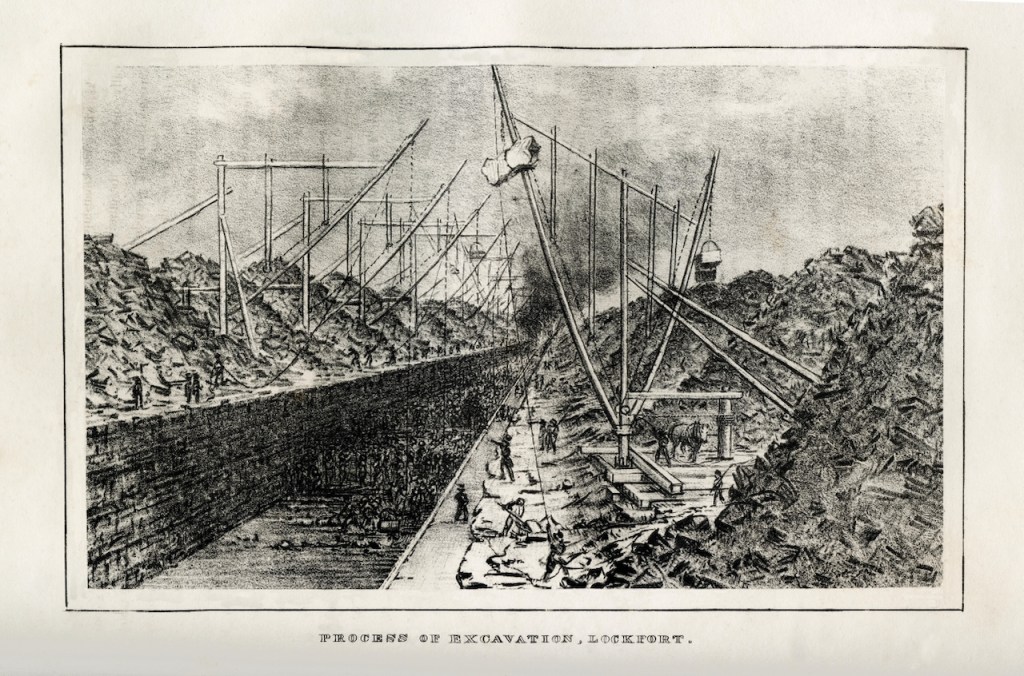
Catlin included illustrations of work leading up to 1825, including the tedious process of removing Niagara escarpment rock between Buffalo and Lockport.
With that rock removed, the drama of navigating the deep cut is captured by Catlin, especially
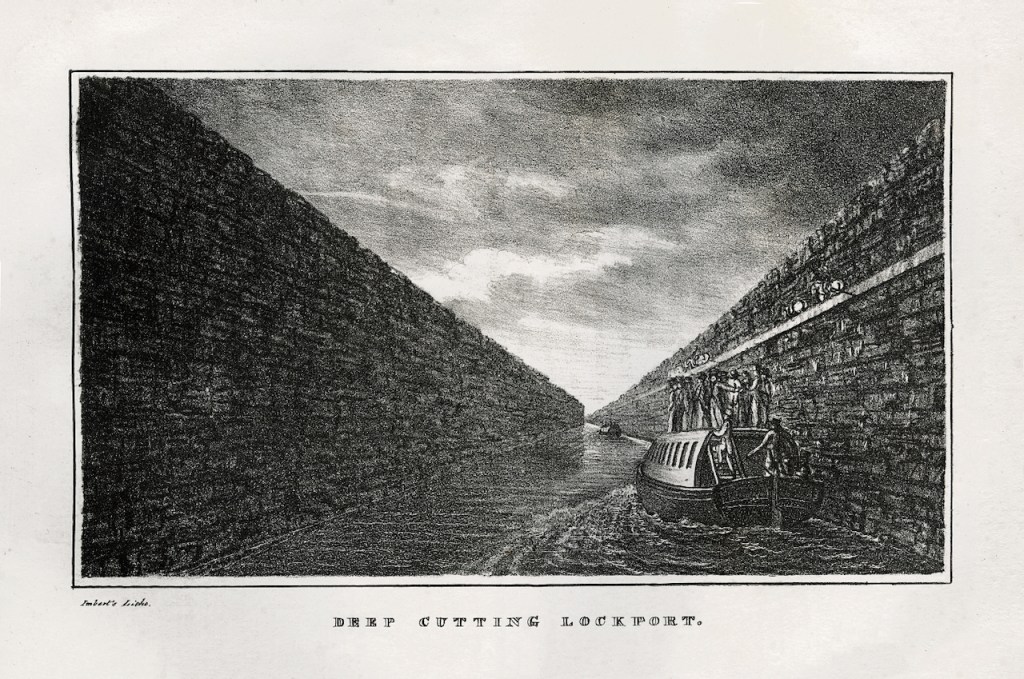
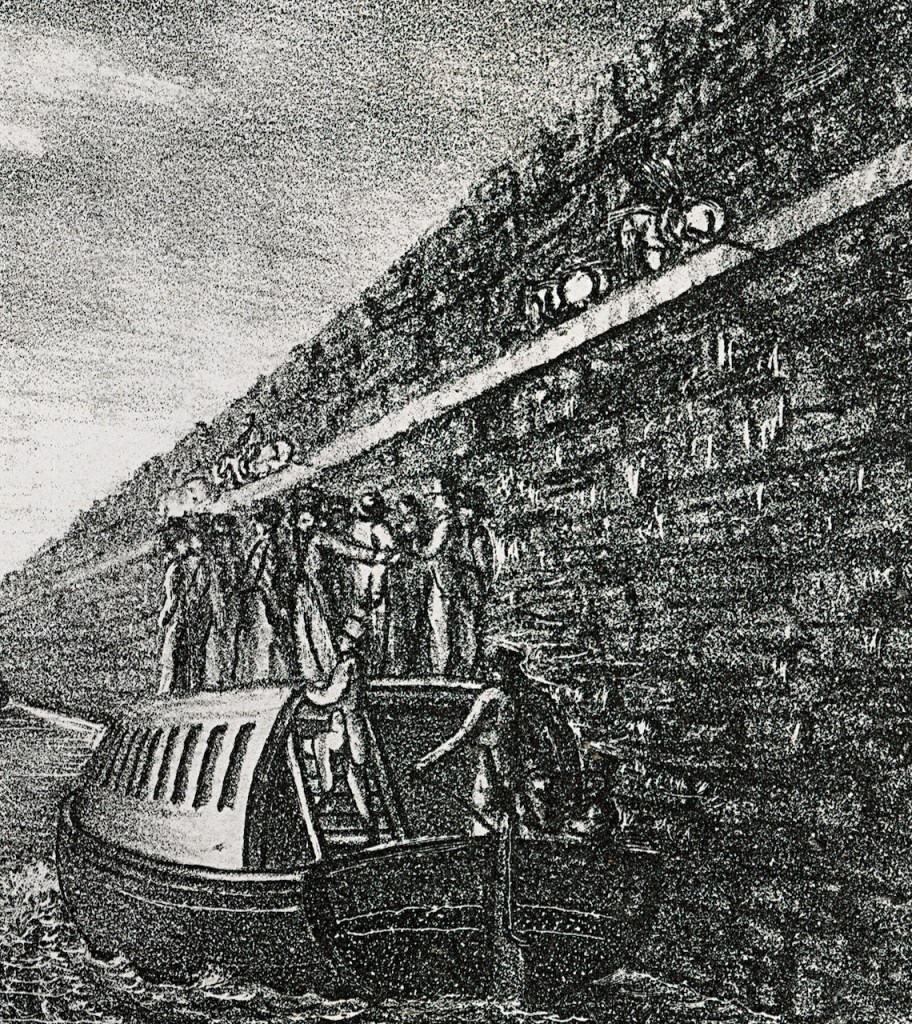
in detail. Note the draft animals on the towpath, where a slip would be fatal.
At Lockport, five locks would lower or raise traffic some 60 feet.
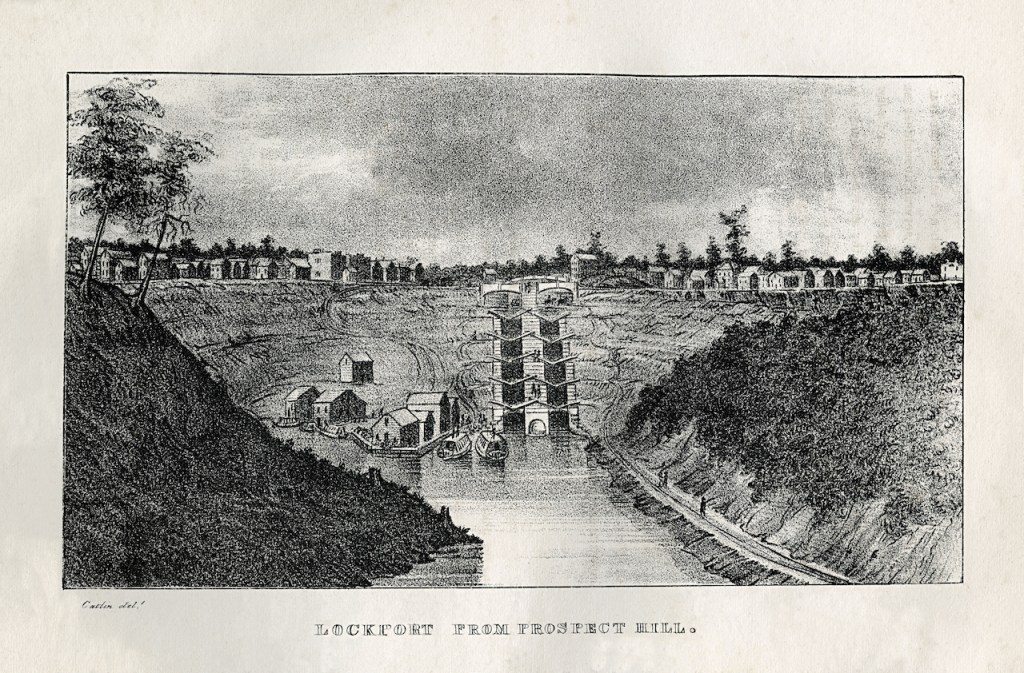
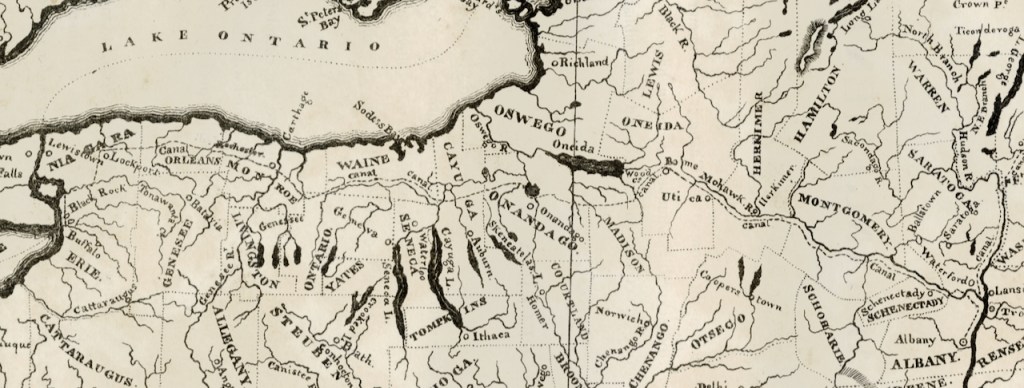
Below a canal boat is towed westward toward the flight of five locks. For Seneca Chief on its eastbound mission to New York City, 78 locks and 18 aqueducts remained.

Here’s a selection from Colden’s Memoir: “The Seneca Chief was superbly fitted up for the occasion, and among other decorations her cabin was adorned with two paintings, of which the following is a description. — One was a view of Buffalo Harbour, a section of Lake Erie, Buffalo Creek, and its junction with the Canal, &c.; the whole representing the scene exhibited at the moment of the departure of the Seneca Chief. The other was a classic emblematical production of the pencil. This piece, on the extreme left, exhibited a figure of Hercules in a sitting posture, leaning upon his favourite club, and resting from the severe labor just completed. The centre shows a section of the Canal, with a lock, and in the foreground is a full length figure of Gov. Clinton, in Roman costume; he is supposed to have just flung open the lock-gate, and with the right hand extended, (the arm being bare,) seems in the act of inviting Neptune, who appears upon the water, to pass through and take possession of the watery regions which the Canal has attached to his former dominions; the God of the Sea is upon the right of the piece, and stands erect in his chariot of shell, which is drawn by sea-horses, holding his trident, and is in the act of recoiling with his body, as if confounded by the fact disclosed at the opening of the lock; Naiades are sporting around the sea-horses in the water, who, as well as the horses themselves, seem hesitating, as if half afraid they were about to invade forbidden regions, not their own. The artist is a Mr. Catlin, miniature-portrait painter. Besides the paintings, the boat carried two elegant kegs, each with an eagle upon it, above and below which were the words — “Water of Lake Erie.” These were filled from the Lake, for the purpose of being mingled with the Ocean on their arrival in New York.”
I’m working my way through the Memoir now, but what caught my attention is the artist, Catlin, whom you may have heard of and seen the work of . . . George Catlin, who at this moment was not yet 30.
Canal Society of New York has several copies of Colden’s Memoir with Catlin’s superb illustrations.


 Dispatches from the Samuel Center
Leave a reply to wshecht01 Cancel reply