Here are more mail bag specimens in the CSNY collection, envelope and note from 1840.
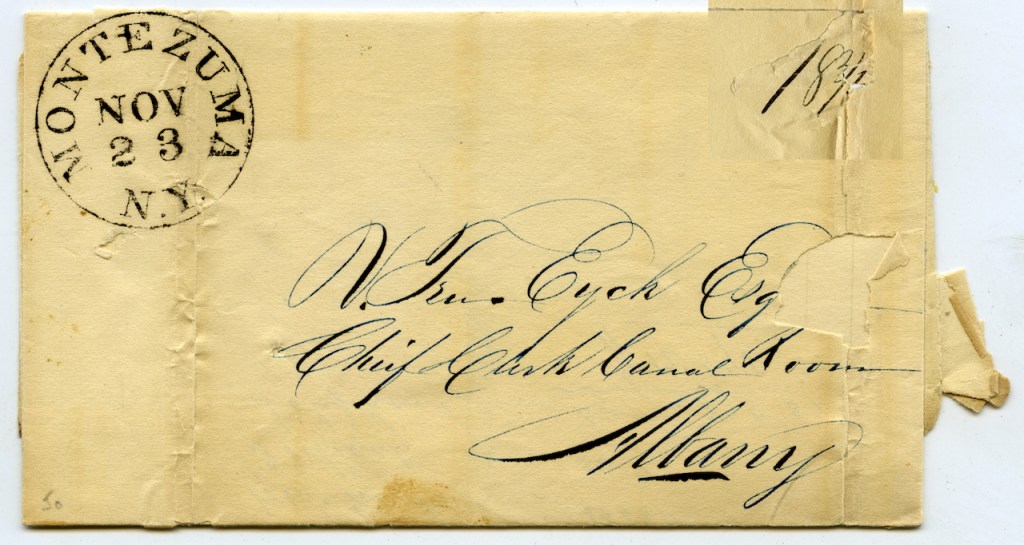
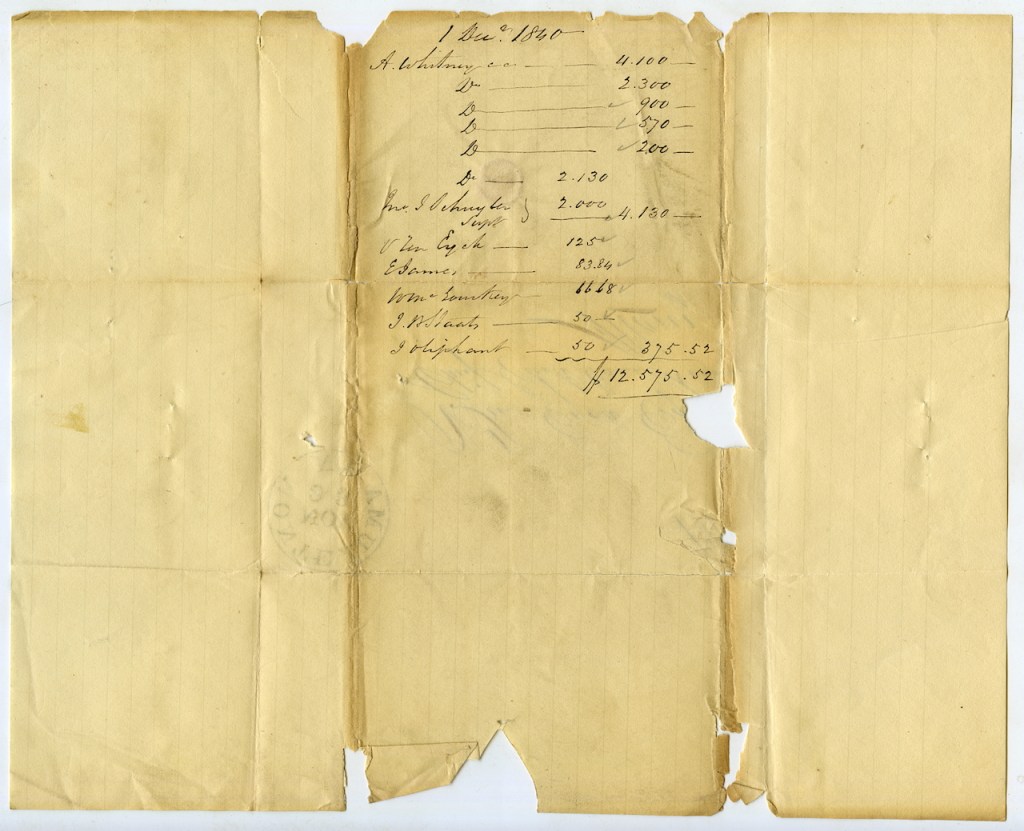
According to Craig Williams, “those named here were all clerks employed by the State’s Canal Fund and the amounts seem to be their pay. Asa Whitney was a Canal Commissioner. Why it is postmarked “Montezuma” I don’t know, but in 1840 the canal collector’s office was located there rather than Port Byron. It might also be someone reusing an envelope to make those notations.”
The latter would not surprise me; paper is much less scarce today. We have a category of scrap paper, and I use it all the time to make lists. In fact, the most common paper I use for daily “to do” lists is in fact the back of envelopes.
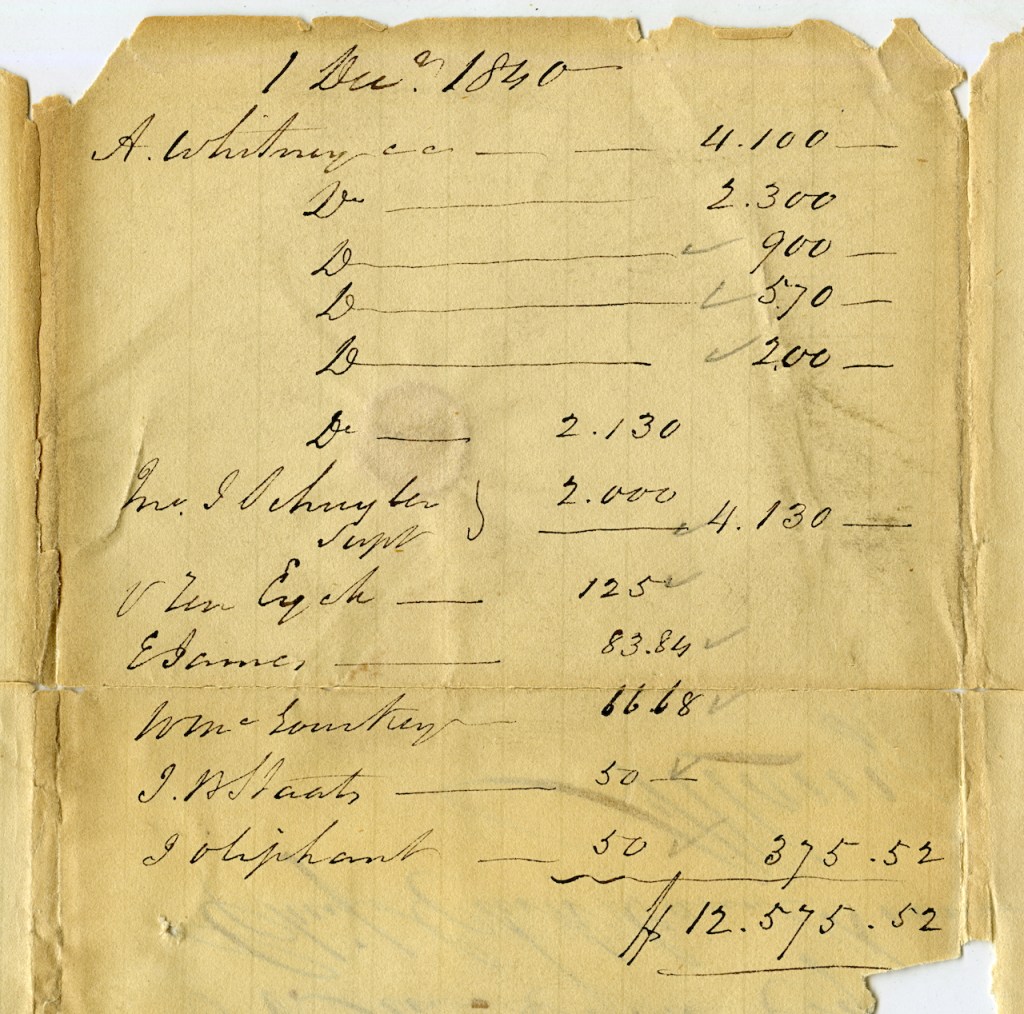
What catches my attention about this note from a long-discarded mail bag is the script. Until fairly recently, a term penmanship was widely used; my elementary school report card even had penmanship as a category. It’s a sore point for me because it was always my lowest score. As a penman–would that be pen person today?–I placed little value on the calligraphy because print was a faster communication for me. I’ll get back to this.
To digress, I do wonder about many other things about these postal artifacts, such as the carrier, the delivery system writ large, the actual wooden-handled rubber stamp, the ink, and the pen itself. Rubber stamp is a term we use to this day, but more commonly as a verb rather than a noun, but I’m mot going down that rabbit hole.
One influencer of penmanship of this era was Platt Rogers Spencer, associated with Spencerian script, seen as the mark of an educated person in the United States. As the child of immigrant parents, I can attest that my parents, especially my mother, had a style of cursive writing–letters, words, and numbers–not similar to US cursive but almost identical to the “hand” of other people of her generation in the Netherlands, i.e., other cultures have their own sense of hand-made font.
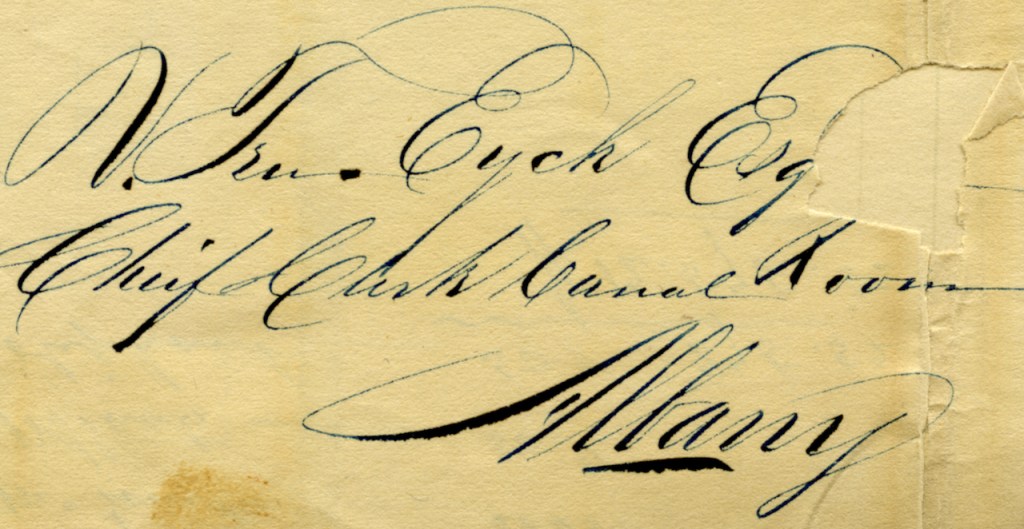
A comment I’ve heard periodically relating to mail bag artifacts is that the cursive writing is an impediment to having younger people transcribe them. I can more easily skim a “typed” text than a handwritten one, in Spencerian script or some other.
I’d love to hear your experiences with cursive writing.



Leave a comment